Genealogists often speak of connections. We search for them in records, reconstruct them through evidence, and celebrate them when we discover how families intersect across time and place. Occasionally, however, those connections seem to take on a life of their own.
In June I had the opportunity to present at a conference devoted to Palatine migration and German-American history. My presentations examined the experiences of German immigrants and their descendants to America and experiences they endured during times of war and discrimination. As I prepared for the final lecture, I had no idea that I was about to experience one of the strangest and most memorable moments of the entire conference.
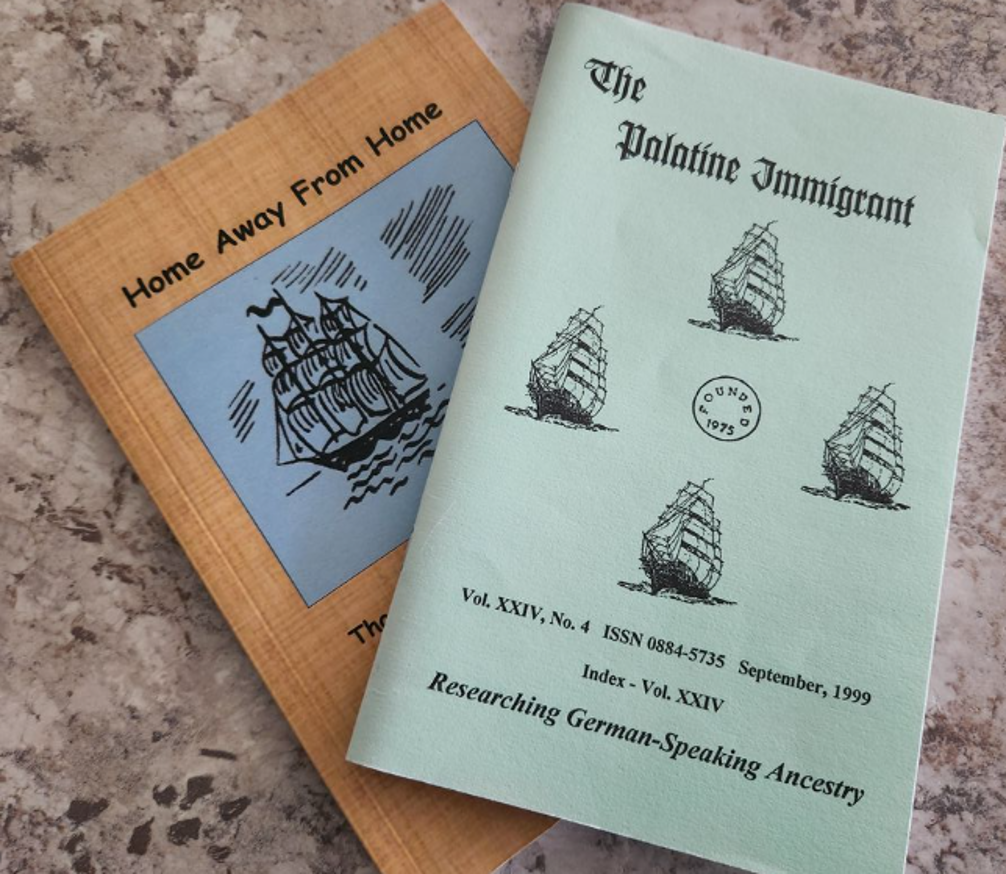
The previous afternoon, I had been browsing through a collection of journals that were being offered to attendees. As I flipped through one issue, I was delighted to discover an article written in 1999 by a distant cousin in Germany. The find made me smile. It is always rewarding to encounter the work of family members who share a passion for history and genealogy.
At that very moment, the conference announcer introduced a representative from an exhibiting organization. To my surprise, the speaker happened to be the spouse of another cousin of the article’s author.
The coincidence made me smile, but the story did not end there.
As I continued paging through the journal, my phone chimed. A text message had just arrived from our shared cousin in Germany. He wished me well and said he hoped my presentation was going successfully.
Before I could finish reading the message, my phone chimed again. This time it was a colleague in the Palatinate with a question about American Revolutionary War research.
I looked at the journal in my hands, listened to the cousin’s spouse speaking before the audience, and glanced at the two messages that had just arrived from Germany.
Three connections. Three individuals. Three entirely separate events occurring within moments of one another.
As genealogists, we spend our lives connecting people across time and distance. Yet every so often, those connections seem to converge in a way that reminds us just how small our world can be.
The following day, during my final presentation, I spoke about the collaborative nature of genealogy. No researcher works entirely alone. We depend on archivists, translators, local historians, distant cousins, and fellow researchers who generously share their knowledge and expertise.
As I concluded my remarks, I displayed a photograph taken at a Christmas market in the Palatinate. The image included several individuals who have contributed to my research efforts over the years. I briefly introduced them and described the unique role each has played in helping me better understand the lives of our shared ancestors.
I held up my phone and showed the audience the timestamps as I described what had occurred the previous afternoon.
The audience laughed and applauded, but many also seemed to appreciate the deeper significance of the moment. These folks clearly understood as one of their lifetime members, Hank Z. Jones, has written two books on Psychic Roots.
Genealogy is often described as the study of the dead. I have never believed that.
Genealogy is fundamentally the study of relationships.
Some relationships connect us to ancestors who lived centuries ago. Others connect us to cousins we have only recently discovered. Still others link us to archivists, historians, translators, and researchers who help us reconstruct the stories of those who came before us.
Most of these connections develop slowly and quietly.
Occasionally, however, they reveal themselves in ways that feel almost magical.
No, I do not believe the texts were supernatural. Nor do I believe fate was orchestrating a dramatic conference finale.
But I do believe that genealogy teaches us to recognize the invisible threads that connect people across time and distance.
On that day, those threads became visible.
A journal article written decades earlier. A conference attendee related through marriate to its author. A photograph taken months before in the ancestral homeland. Messages arriving from Germany at precisely the right moment.
What are the odds?
Perhaps that is the wrong question.
The better question may be this: How many connections surround us every day that we simply fail to notice?
Genealogists spend their lives looking for connections.
Sometimes, if we are fortunate, the connections find us.